The Spanish
pronunciation dictionary.
Type any word or phrase. Hear it in three regional accents — Mexican, Castilian, Rioplatense. See every sound broken down so you can hear it, understand it, and say it back.
Results appear here
The tool you reach for the second before you speak.
Anywhere Spanish shows up in your life — and you want to say it right the first time.
The waiter's coming. You don't want to butcher huitlacoche. Type it, hear it, order with confidence.
You've never typed suegra before. You'd rather not invent your own pronunciation in front of your partner's family.
Your favorite song just dropped a word you've never said out loud. Pause, look it up, sing it right.
Her name is Guadalupe and you get one shot to nail it. Practice three times in your head.
The back of the spice jar says achiote. You're cooking with your kid. Say it like you've said it a hundred times.
Tomorrow's meeting might be in Spanish. Go in confident and impress the group with your improved accent.
What's inside Dilo.
Two tools for better pronunciation. Use whichever one you need.
Hear it
Type a word or phrase. Hear it spoken.
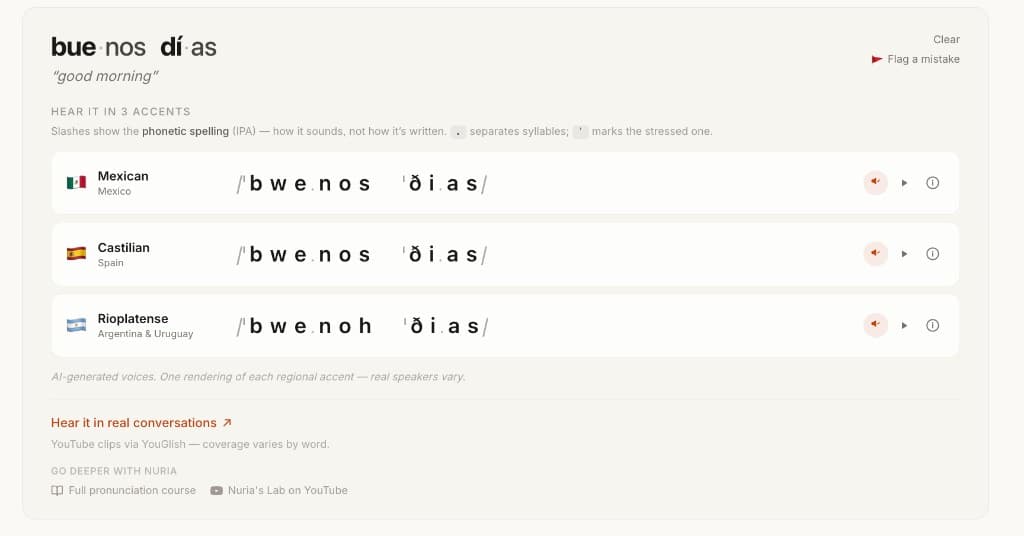
- Three regional accents, side by side — Mexican, Castilian, Rioplatense. Regional voices so you hear real pronunciation, not the flattened output of a generic text-to-speech engine.
- Sound-by-sound breakdown — every lookup shows the phonetic transcription split into individual sounds, each one linked to the phoneme chart so you can isolate what you're hearing.
- Anything you type — no fixed lessons, no path. The words you need to hear are the words you need to hear.
Understand it
Then dig into how to form the mouth position to make the sound correctly.
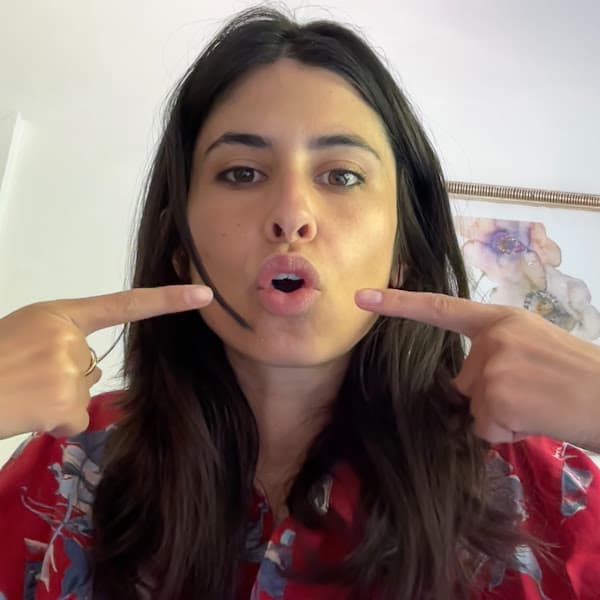
- Mouth and tongue position diagrams — for the sounds that consistently trip learners up: rolled rr, ñ, the difference between Spanish b and v, the various c/z/s realizations across dialects.
- Short video explanations — walking through why Spanish does what it does: n becoming m before p, vowels merging across word boundaries, sheísmo, yeísmo, ceceo.
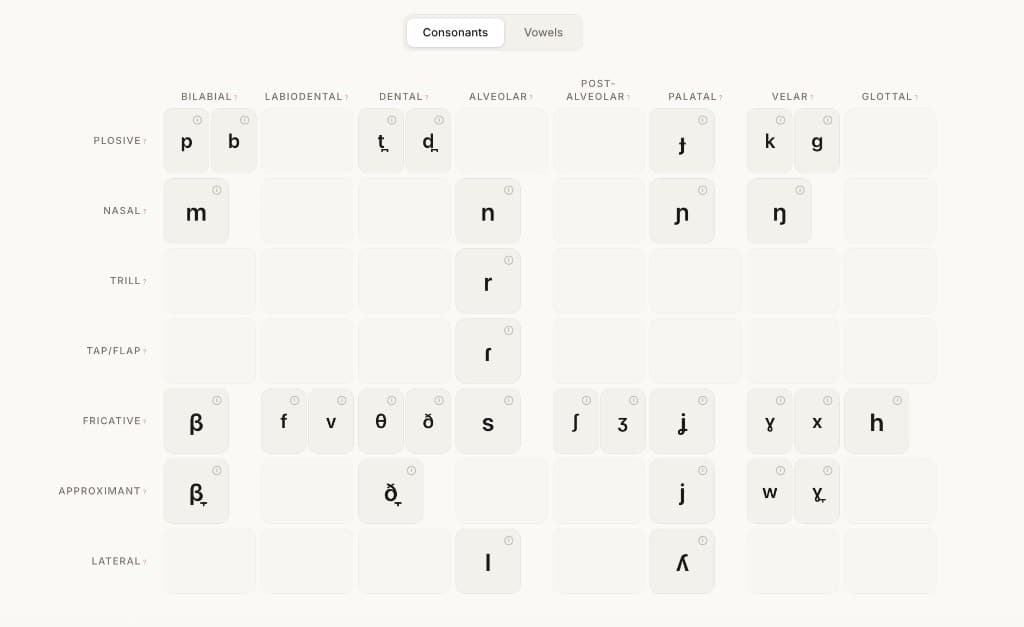
- Interactive Spanish phoneme chart — every sound in Spanish, tappable, with isolated audio across all three dialects.
- Fast vs. slow speech notes — so when a native speaker drops three syllables into one, you know what they did and how to do it back.
If you just want to hear a word and move on, you'll be done in two seconds. If you want to know why your tongue isn't in the right position, the explanation is one click deeper.
Who's behind Dilo
Nuria
Nuria is a native Spanish speaker and teacher from Spain, with a degree in Education and a background in acting. For years, she's worked one-on-one with English-speaking learners on the two things most courses skip: the real sounds of Spanish, and the way native speakers connect those sounds into real speech.
Her students don't work with her for generic grammar drills or vocabulary. They come to her because they're tired of sounding like just another Spanish learner, tired of being switched to English mid-sentence, and tired of freezing when a native speaker talks at normal speed. Beginners she works with sound more native from their very first sentence. Intermediates finally start understanding what it is they've been hearing for years.
Dilo is the tool she dreamed up to help her students with pronunciation and comprehension whenever they need it.
Google Translate gives you meaning. Dilo gives you sound.
Translation tools are great when you need to know what a word means. They're terrible at telling you how it's said — especially across dialects. That's the gap Dilo fills.
Build your ear over time, not just in one session.
One lookup helps. But pronunciation clicks when you keep coming back — replaying the words that tripped you up, adding new phrases as you encounter them, and reviewing before a conversation or trip.
Personal library
Every word and phrase you look up is saved to your account. Replay any lookup instantly — the audio and breakdown are always there.
Full phrases, not just single words
Type multi-word phrases and hear how they connect in speech — where syllables merge, where stress shifts, what drops out entirely.
Export to Anki or Quizlet
Take your library into your existing study flow. Build pronunciation flashcards from the words you looked up.
Three accents on every lookup
Mexican, Castilian, and Rioplatense — so you train your ear for the Spanish you're going to hear, wherever you are.
Why this exists
Written Spanish and spoken Spanish are two different things.
Words run into each other, vowels combine, and consonants shift depending on what's next to them. So un poco ends up sounding like um-POH-koh, and voy a comer comes out as one connected bwah-koh-MER.
Same words. Different sounds out loud. Most courses don't show you this gap, which is why fast conversation can stop making sense even when you know every word on the page.
You already do this in English.
Every language has a written form and a spoken form, and they aren't the same. English does it without you noticing.
The reason fast Spanish feels hard to keep up with is because you've been listening for the written form of the words and native speakers are saying something shorter and more connected… which sounds “faster.”
Why it's only $39 for lifetime access, and why only for the first 100.
Dilo is in beta. We're rolling it out now and adding new sounds, videos, and features every week. The first 100 people who grab lifetime access are getting in early — and locking in a price that won't exist later.
Once the 100 spots fill, the lifetime option goes away and Dilo moves to a monthly subscription. If you're in the first 100, you keep everything — no subscription, no price increases, no matter what Dilo becomes.
What you get for $39
- 300 new lookups every month — words and phrases not yet in our public library
- Unlimited long phrases — names, lyrics, idioms, full sentences
- English → Spanish — type English, get the translation pronounced in 3 accents
- Library export — Anki deck or Quizlet text, study offline
- Every future feature — new accents, new videos, new tools, all yours
- One payment, forever — no subscription, no recurring charges
Limited spots remaining
Pick what fits.
Start free — look up any word, explore the phoneme chart, and save your first lookups without paying. Upgrade when you want phrases, more saves, and export.
Free
- Unlimited single-word + short-phrase lookups
- 5 lifetime trials of custom 4+ word phrases
- Personal library — replays free, forever
- All 3 regional voices on every lookup
- Full phoneme chart, free for everyone
Lifetime
- 300 lookups every month
- Multi-word phrases unlocked
- English → Spanish translation (with alternates)
- Library export (Anki / Quizlet)
- Every future feature, free
- One payment. Forever.
Just need a few extra lookups? Buy credits from $5 — pay as you go, no subscription.
Browse by category
Common Spanish words grouped by how you'll use them. Click any to hear it in three regional accents.
Greetings & farewells
Hello, goodbye, and the things you say in between.
Courtesy phrases
Please, thank you, sorry — the polite glue of every conversation.
Question words
Who, what, where, when, why, how — the building blocks of curiosity.
Food & drink
The vocabulary you reach for at a restaurant or a market.
Numbers
Counting one through ten — and a few useful higher ones.
Common verbs
The handful you'll use in every conversation.
Try it with a word or phrase that's been giving you trouble.
Free to try, no card required.